
A client I worked with recently asked me to help redesign their customer journeys. On paper, they were doing many things right. Multiple journey maps existed, each owned by a different business unit, each carefully detailed and visually impressive.
And yet, the same frustrations kept surfacing. Customers experienced inconsistency. Employees were unsure which journey mattered most. Improvements were discussed enthusiastically, but execution lagged behind.
When we stepped back and looked at the situation, the issue wasn’t a lack of journey mapping. It was an excess of it — without a unifying logic.
That moment captures a problem I see in many organizations. Journey mapping has become a popular CX tool, but in practice it often creates complexity instead of clarity.


The Hidden Limitations of Traditional Journey Mapping
Traditional journey mapping usually focuses on individual products, services, or customer segments. Each team creates “their” journey, optimized for their context and objectives. While this makes sense locally, it creates unintended consequences at the organizational level.
Journeys multiply. Language diverges. Ownership becomes unclear. Over time, journey maps move into silos, then into drawers, and eventually into presentation decks that are rarely revisited.
I often hear leaders say, “We have journey maps — we just don’t use them.” The problem is not the maps themselves. It’s that there is no shared reference point that connects them.
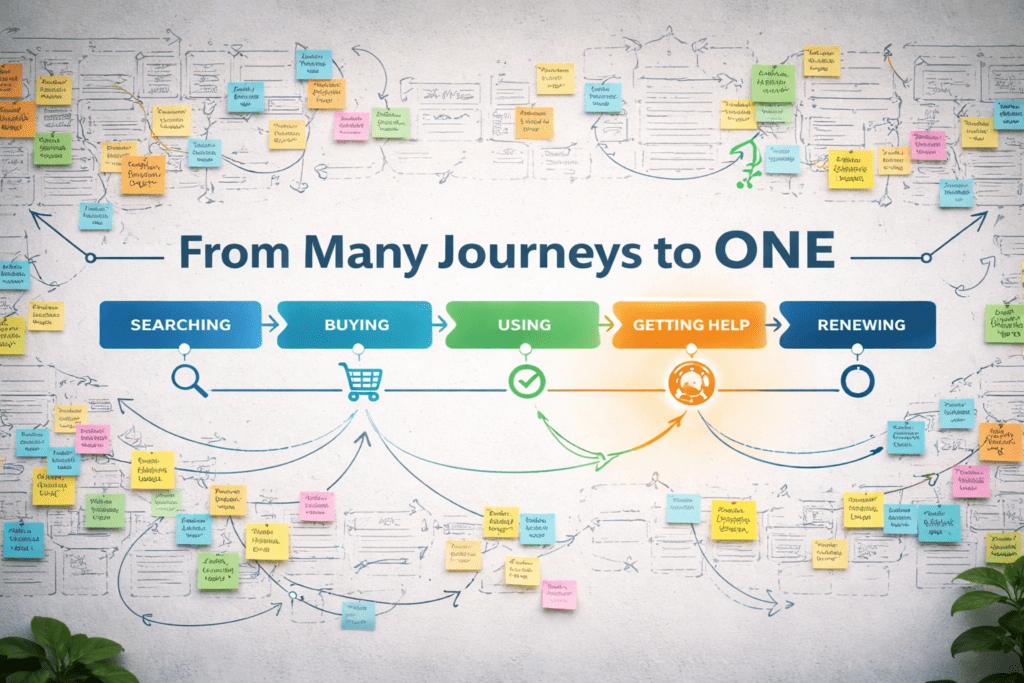
From Many Journeys to ONE
This is exactly where ONE Customer Journey Mapping comes in.
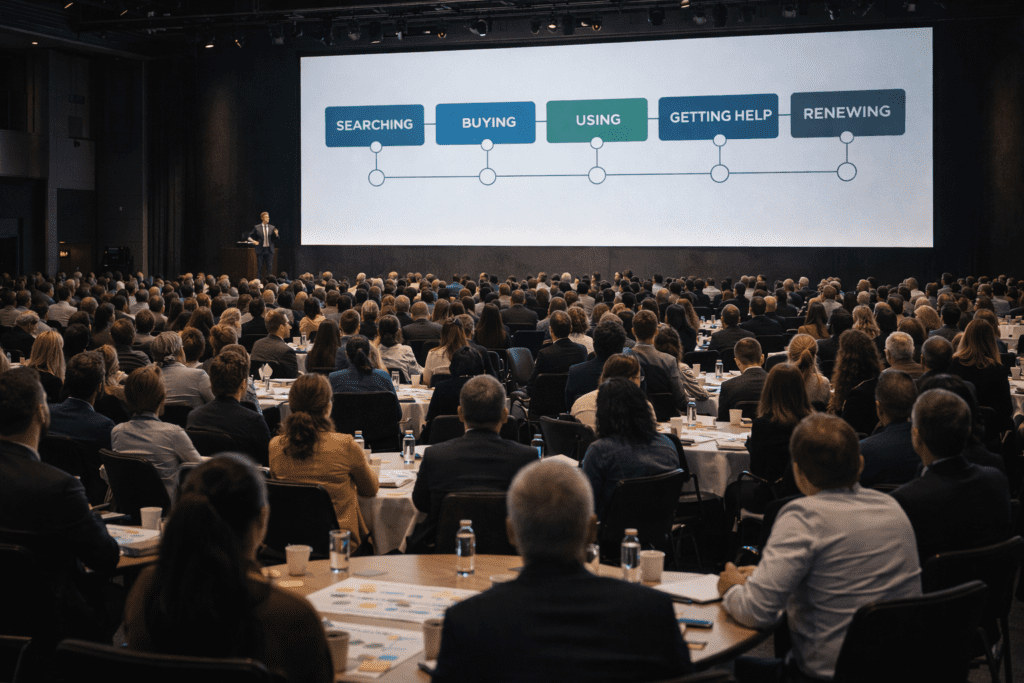
Instead of starting with individual journeys, the approach starts by identifying one common set of journey phases that applies across the organization. Regardless of product, channel, or customer type, customers tend to move through a limited number of universal phases — such as searching, buying, using, getting help, and renewing.
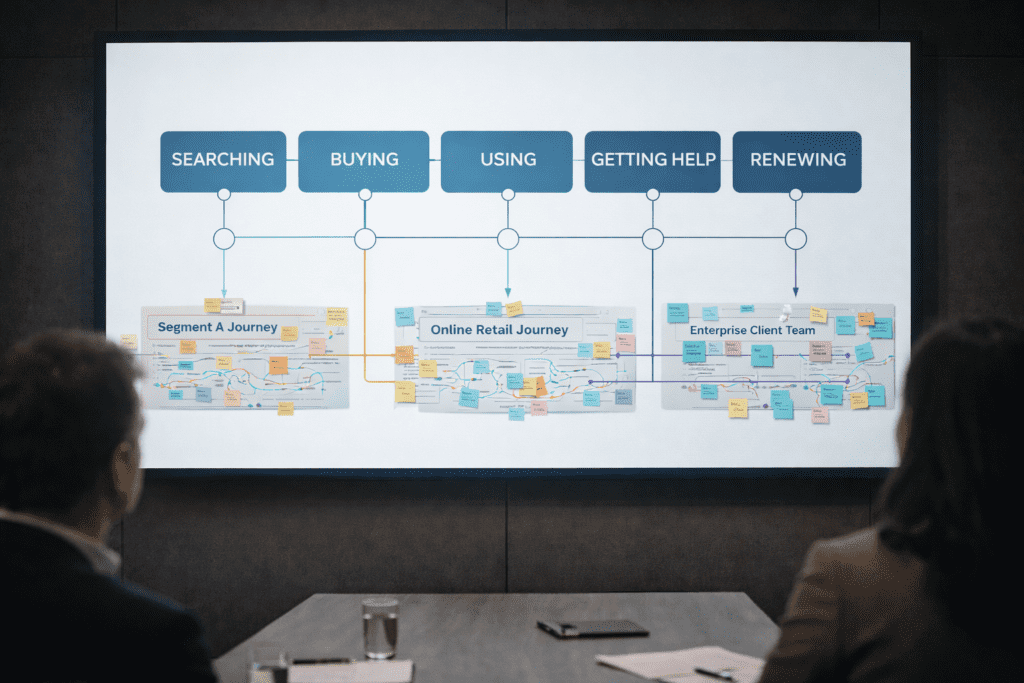
By agreeing on this shared structure first, organizations create a common backbone for all journey work. Individual journeys don’t disappear, but they are aligned to the same meta-journey. Suddenly, teams are no longer speaking different languages about experience.
What changes is not just the map, but the conversation.
Journey Mapping as a Cultural Anchor
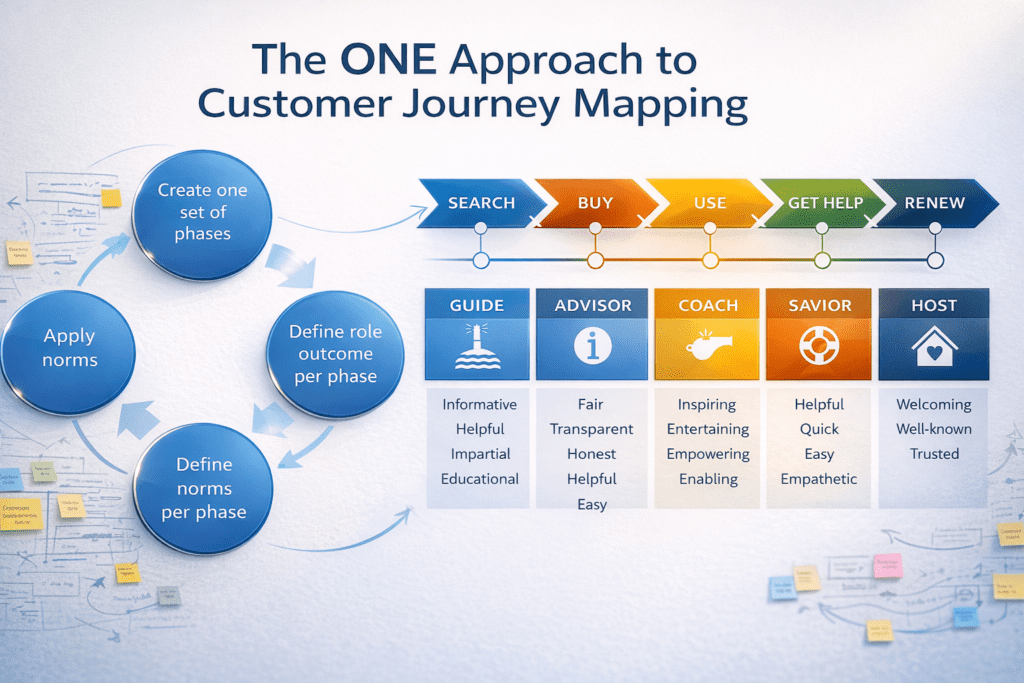
ONE Journey Mapping deliberately goes beyond touchpoints and emotions. It asks a deeper question: Who do we want to be for our customers in each phase of the journey?
In practice, this means defining clear norms and role models per journey phase. In one phase, the organization might need to act as a guide. In another, as a trusted advisor. In moments of failure, perhaps as a savior.
This step turns journey mapping into a cultural exercise, not just a design one. Employees begin to understand not only what needs to happen, but how it should feel — and what behavior is expected of them.
I’ve seen this shift unlock engagement in a way traditional mapping rarely does. People recognize themselves in the journey. They see how their role contributes to the whole.
What Happens When Everyone Aligns Around ONE Journey
In one large, complex organization I worked with — operating at national scale — we applied the ONE Journey Mapping approach across multiple functions. Teams from different areas contributed their perspectives, consolidated their insights, and ultimately aligned around a single, shared journey model.
The result was not just better maps. It was better decisions. Improvement initiatives became easier to prioritize. Trade-offs were discussed more constructively. Most importantly, employees across the organization finally had a common reference point for what customer centricity meant in practice.
That organization later received international recognition for the quality of its citizen experience. While the award itself was gratifying, the more meaningful outcome was the internal shift: customer centricity had moved from aspiration to shared behavior.
Why ONE Journey Mapping Works
What makes ONE Journey Mapping different is not a new canvas or a clever framework. It’s the discipline of alignment.
By creating one shared journey structure, defining behavioral norms, and involving people bottom-up, the method turns journey mapping into a management system rather than a documentation exercise. It reduces complexity, increases ownership, and creates a strong link between CX strategy, culture, and execution.
Journey mapping stops being something teams do occasionally and starts becoming something the organization uses continuously.
A Thought to Leave You With
If your organization has many journey maps but no shared journey language, the problem isn’t a lack of effort. It’s a lack of alignment.
Customer journey mapping done right is not about drawing more detailed maps. It’s about creating one clear reference point that everyone can work with.
The question is no longer whether you have journey maps.
It’s whether you have ONE journey everyone believes in.